
Updated October 5, 2026 · By the Casino Online Japan editorial team · This page contains affiliate links: we may earn a commission when you sign up through them, which never affects our scores (how we rate).
Searching “is gambling legal in Japan” gives you two kinds of answers: travel blogs that stop at pachinko, and law-firm reports written for operators. This guide is written for players. It sets out what Japanese law actually says, what is clearly allowed, how the rules treat online casinos, and how to check the licence of any site before you deposit — with every point linked to the official source and checked in October 2026.
Quick answer (October 2026)
- Gambling is restricted, not banned outright. The Penal Code (Articles 185–187) prohibits gambling in general, and special laws carve out exceptions: horse, bicycle, boat and motorcycle racing, lotteries and the toto football pools. Pachinko operates as an “amusement” business under separate rules.
- Japanese law has no licensing system for online casinos. No online casino holds a Japanese licence; the sites Japanese players use are licensed abroad — mainly in Curaçao and Anjouan, some in Malta or the UK.
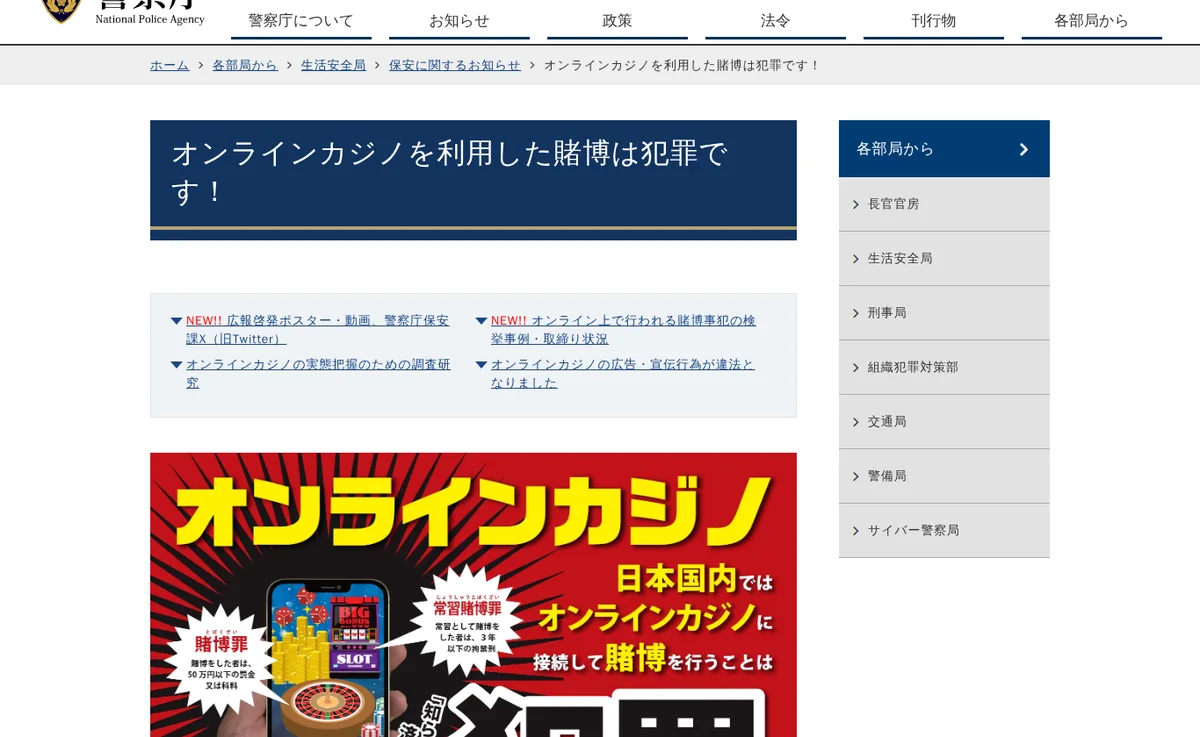
- The official position: the National Police Agency (NPA) states that betting at an online casino from inside Japan is gambling under the Penal Code, even when the operator is legally licensed overseas.
- Since 25 September 2025 a revised law also bans showing illegal online gambling sites and apps to people in Japan and posting content that steers them there — a rule aimed at operators and promoters.
- Land casinos are coming: the Osaka integrated resort (IR) is targeting an opening in autumn 2030.
- How the law applies depends on where you are. Check the rules of the country you live in before you play — that part is your own responsibility.
| Common question | Short answer | Basis |
|---|---|---|
| Is there a Japanese online casino licence? | No — Japan has no licensing system for online casinos | e-Gov (current laws) |
| Are the overseas operators licensed? | Yes — mainly in Curaçao and Anjouan, some in Malta or the UK | Each regulator’s public register |
| Official view of betting from inside Japan | It is gambling under the Penal Code | National Police Agency, Consumer Affairs Agency, government public relations |
| “One Smart Live player was never prosecuted” | Wrong — all three received summary fines | Cabinet written answer, 28 February 2020 |
| The 2025 amendment | Bans showing people in Japan illegal gambling sites and apps, and steering them there | Act No. 76 of 2025 (in force 25 September 2025) |
| Casinos abroad on holiday | The law of the country you are in applies | Penal Code Articles 1 and 3 |
Contents
- Is gambling legal or illegal in Japan?
- What Japanese law allows: public gambling
- Pachinko and the three-shop system
- Casinos: the IR Act and Osaka 2030
- What the law says about online gambling
- The Smart Live case (2016)
- The 2025 amendment: what changed
- What is clearly illegal
- Offshore licences explained
- How to verify a casino licence
- Foreign residents, tourists and Japanese abroad
- Gambling age in Japan
- Tax on gambling winnings
- Is sports betting legal in Japan?
- Is poker legal in Japan?
- Responsible gambling: help in English and Japanese
- Common myths
- Timeline
- Bottom line
- FAQ
- Sources
This page is general information, not legal advice. It is reviewed whenever the law or the official guidance changes. Only the laws of the place where you are apply to you; for a specific situation, ask a qualified lawyer.
Is gambling legal or illegal in Japan? The Penal Code in plain English
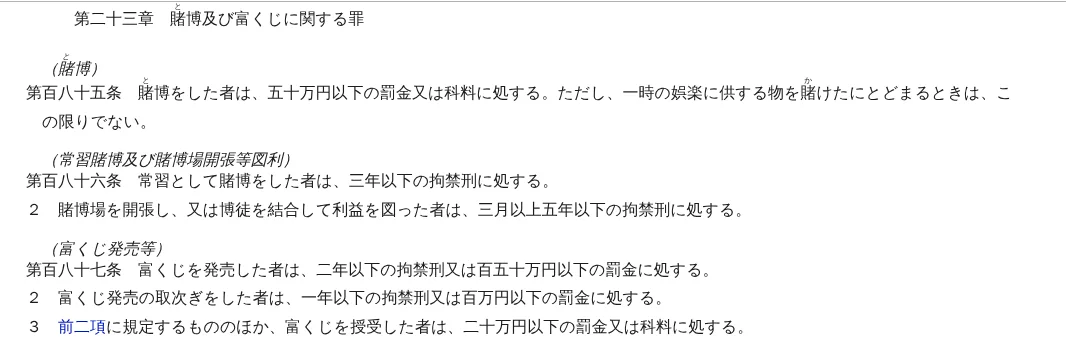
Japan’s starting point is a general prohibition. Chapter 23 of the Penal Code, “Crimes related to gambling and lotteries”, dates from 1907 and is still in force in its current wording (Penal Code (e-Gov Law Search), checked October 5, 2026). Everything legal in Japanese gambling — the races, the lotteries, toto — exists because a later, specific law made an exception for it. That is why the honest answer to “is gambling illegal in Japan?” is: gambling is illegal unless a law specifically allows it.
Articles 185–187 at a glance
| Article | What it covers | Penalty in the current text |
|---|---|---|
| 185 — Gambling | Anyone who gambles | Fine of up to ¥500,000 or a petty fine |
| 186(1) — Habitual gambling | Gambling repeatedly, as a habit | Imprisonment of up to 3 years |
| 186(2) — Running a gambling place | Opening a gambling venue or organising gamblers for profit | 3 months to 5 years’ imprisonment |
| 187 — Lotteries | Selling, brokering or receiving tickets of an unauthorised lottery | Up to 2 years or ¥1.5m fine (seller); lower for brokers and buyers |
Source: Penal Code Articles 185–187, e-Gov Law Search (current version), checked October 5, 2026. Since 1 June 2025 Japanese law uses the single term “kokinkei” (imprisonment) instead of the old “choeki”; the length of the penalties did not change.
The “temporary amusement” exception
Article 185 ends with a proviso: it does not apply when the stake is only “something for momentary entertainment”. This is the rule that makes a friendly bet on who pays for lunch a non-issue. It is read narrowly: food and drink consumed on the spot qualify; cash, and things that work like cash, generally do not.
Why the exceptions are legal
Racing and lotteries are run by public bodies under their own statutes — the Horse Racing Act, the Bicycle Racing Act, the Motorboat Racing Act, the Small Motor Vehicle Racing Act, the Lottery Tickets Act and the Sports Promotion Lottery Act. Each law defines who may run the game, how much must be returned to bettors and who may buy. Activity carried out under such a law is treated as lawful conduct under Article 35 of the Penal Code. Private companies cannot copy these games, and no equivalent law exists for online casinos.
What Japanese law allows: public gambling (kōei gyanburu)
Japan has six forms of state-sanctioned gambling, plus the special case of pachinko. They are big business: central horse racing alone took ¥3.5 trillion in the 2025 business year. All of them can be played legally from inside Japan, most of them online through the organisers’ own betting services.
| Game | Law | Ministry | Minimum age | Return to players | Sales (latest year) |
|---|---|---|---|---|---|
| Central horse racing (JRA) | Horse Racing Act; JRA Act | Agriculture (MAFF) | 20 | 70–80% by bet type | ¥3.52 trillion (2025) |
| Local horse racing (NAR) | Horse Racing Act | Agriculture (MAFF) | 20 | 70% or more | ¥1.15 trillion (FY2025) |
| Boat racing (kyōtei) | Motorboat Racing Act | Land, Infrastructure (MLIT) | 20 | 75% or more | ¥2.67 trillion (FY2025) |
| Keirin (bicycle racing) | Bicycle Racing Act | Economy (METI) | 20 | 70% or more | ¥1.55 trillion (FY2025) |
| Auto race (motorcycles) | Small Motor Vehicle Racing Act | Economy (METI) | 20 | 70% or more | ¥129.7 billion (FY2025) |
| Takarakuji (lottery) | Lottery Tickets Act | Internal Affairs (MIC) | No legal minimum | Max. 50% (46.5% in FY2024) | ¥759.8 billion (FY2024) |
| toto / BIG (sports lottery) | Sports Promotion Lottery Act | Education, Sports (MEXT) | 19 | 50% | — |
Sources: the statutes on e-Gov (age limits: Horse Racing Act Art. 28, Bicycle Racing Act Art. 9, Small Motor Vehicle Racing Act Art. 13, Motorboat Racing Act Art. 12, Sports Promotion Lottery Act Art. 9); sales and payout data from JRA, NAR, BOAT RACE Promotion Association, JKA and the official Takarakuji site, compiled on our Japanese guide to public gambling (verified October 4, 2026).
Horse racing
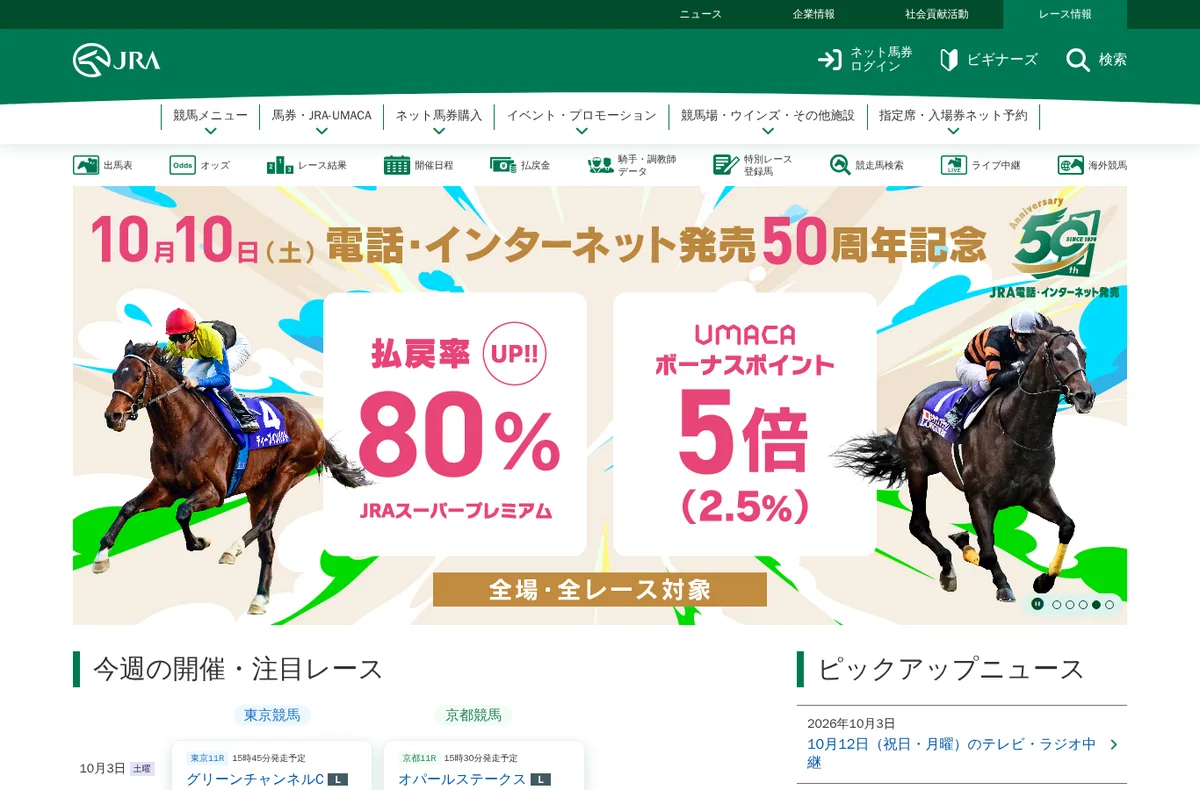
The Japan Racing Association (JRA) runs central racing at ten courses; prefectures and municipalities run local racing. Payout rates are set by bet type: 80% for win and place, 77.5% for bracket quinella, quinella and wide, 75% for exacta and trio, 72.5% for trifecta and 70% for WIN5. Online betting through the JRA’s own service is fully legal for adults aged 20 and over.
Boat racing, keirin and auto race
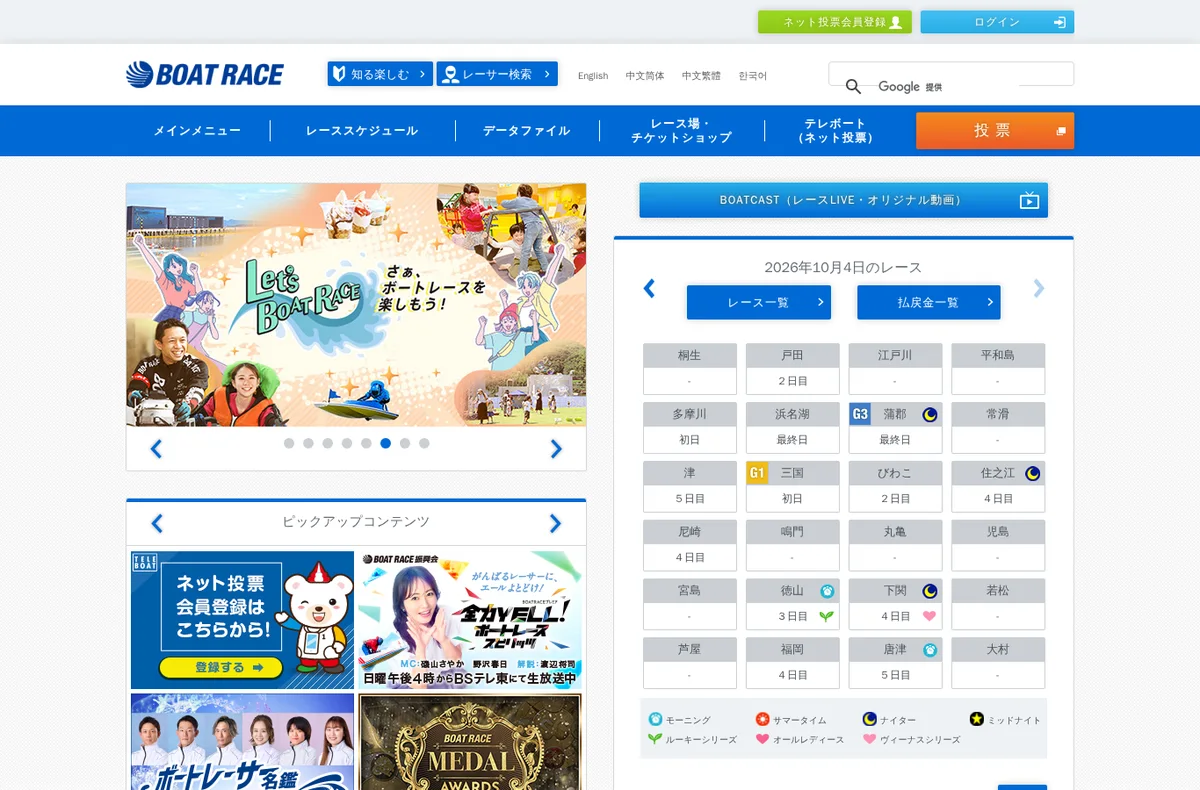
Boat racing has the highest legal minimum payout (75%) and is the most online of all: around 81% of its FY2025 sales came through phone and internet betting. Keirin and auto race are run by local governments with promotion by the JKA; their returns are 70% or more. Each has an official online betting service (Teleboat, KEIRIN.JP, AUTORACE.JP).
Lotteries and toto
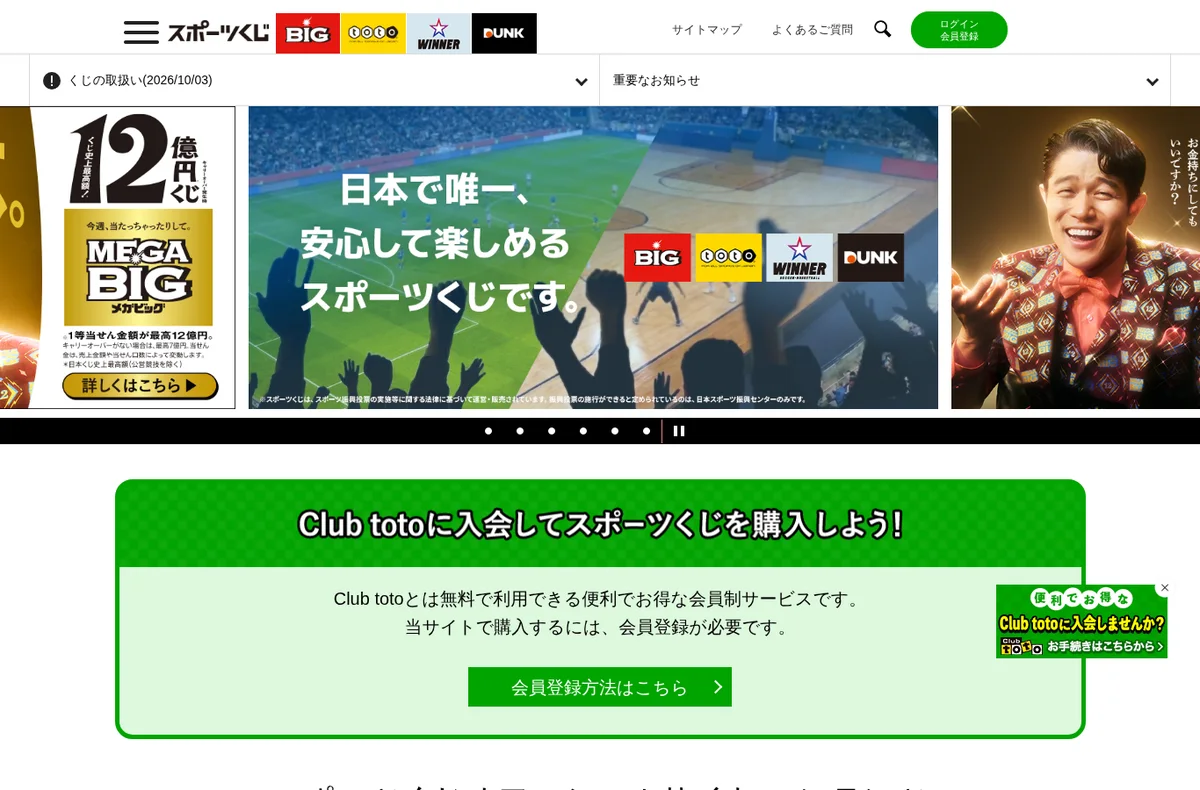
Takarakuji is sold by the 47 prefectures and 20 designated cities with the approval of the Minister for Internal Affairs; the law caps total prizes at 50% of sales. toto and BIG, run by the Japan Sport Council, let you bet on J.League football and B.League basketball results — the closest thing to legal sports betting in Japan. Prizes from both are tax-free.
Pachinko and the three-shop system
Pachinko is the most visible form of gaming in Japan and the one foreign visitors ask about most. Legally it is not public gambling: pachinko parlours are private businesses licensed by each prefecture’s Public Safety Commission under the Amusement Business Act (e-Gov) (the “Fūeihō”). The police, not a ministry of sport or industry, supervise them.
What the Amusement Business Act forbids
Article 23 of the Act prohibits a pachinko parlour from (1) giving cash or securities as prizes, (2) buying back the prizes it gave to customers, (3) letting customers take balls or medals out of the premises, and (4) issuing receipts for balls kept on a customer’s behalf. Players exchange balls for prizes — and that is where the parlour’s role legally ends.
How the three-shop system works
- The parlour exchanges your balls for “special prizes” (small tokens, often encased in plastic).
- A separate exchange counter, usually a small window nearby run by a different business, buys those prizes for cash.
- A wholesaler buys the prizes from the exchange counter and supplies them back to the parlour.
The government’s view of this arrangement is on record. In a written answer to the Diet, the Cabinet said that a third party other than the parlour operator buying the prizes “does not immediately violate” Article 23(1)(ii) — but that if the third party is effectively the same as the operator, it can be a breach of the Act and fall under Article 185 of the Penal Code (Cabinet written answer No. 157, 29 November 2016). In short: pachinko is legal because the parlour and the exchange are kept separate.
| Public gambling (racing, lotteries) | Pachinko / pachislot | |
|---|---|---|
| Run by | National or local government bodies | Private businesses licensed by prefectural Public Safety Commissions |
| Legal basis | Horse Racing Act, Lottery Tickets Act, etc. | Amusement Business Act |
| Supervisor | MAFF, METI, MLIT, MIC, MEXT | Police |
| What you receive | Cash payouts | Prizes (cash prizes and buy-backs by the parlour are banned) |
| Minimum age | 20 (19 for toto; none for lotteries) | 18 (Art. 22: no entry for under-18s) |
Online “pachinko” on offshore casino sites is a different product: it is a slot-style game played for money on a server abroad, not an Amusement Business Act parlour. Our guide to pachinko explains how the machines work and where the online versions fit.
Casinos in Japan: the IR Implementation Act and Osaka 2030
Japan has no licensed land casino open today, but it has a law to build them. The Act on Development of Specified Integrated Resort Areas (IR Implementation Act (e-Gov)), passed in 2018, allows casino gaming only inside a government-approved integrated resort, run by a licensed casino operator and supervised by the Casino Regulatory Commission. The law limits the number of approved IR plans to three.
Entry rules in the IR Act
| Rule | Foreign visitors (non-residents) | Japanese nationals and residents of Japan |
|---|---|---|
| Minimum age | 20 | 20 |
| Entry fee | None | ¥6,000 per 24 hours (¥3,000 national + ¥3,000 prefectural) |
| Visit limit | None | Max. 3 entries in any 7 days and 10 in any 28 days |
Source: IR Implementation Act Articles 69, 176 and 177 (e-Gov, checked October 5, 2026).
Osaka IR timeline
| Date | Milestone |
|---|---|
| July 2018 | IR Implementation Act enacted |
| 14 April 2023 | Minister of Land, Infrastructure, Transport and Tourism approves the Osaka IR plan |
| 22 September 2023 | Implementation agreement between Osaka Prefecture and the operator approved |
| Autumn 2030 (target) | Opening of the Osaka IR on Yumeshima island, run by MGM Osaka (core shareholders MGM Resorts Japan and ORIX) |
Sources: Japan Tourism Agency (MLIT), Osaka IR timeline; City of Osaka, Osaka IR page (both checked October 5, 2026). Until then, the casinos you can visit in Japan are “amusement casinos” where chips have no cash value. See our guide to casinos in Japan for what to expect at the Osaka IR and where to play casino games for fun today.
The IR Act matters for one more reason: it is the clearest sign of how Japan approaches casino gaming — licensed, physically located and closely supervised. It does not cover online casinos, and no bill to license online gaming has been put forward.
What Japanese law says about online gambling
There is no Japanese online casino licence
No Japanese statute licenses online casinos, and no Japanese authority issues licences for them. That is the single most important fact for anyone researching the topic: every online casino available to players in Japan — including the well-known brands with Japanese-language sites and yen accounts — is licensed by a regulator outside Japan. Licences from Curaçao, Anjouan, Malta and the UK allow a company to operate under that jurisdiction’s rules. They are a real and useful guarantee of who runs a site and who supervises it, but they are not Japanese permits.
The official position
The National Police Agency states on its online casino page that betting at an online casino by connecting from inside Japan is a crime, even if the casino is legally operated abroad, and that this applies whatever the game is called — baccarat, slots or sports betting (National Police Agency, online casino page, checked October 5, 2026). The Consumer Affairs Agency and the government’s public relations site say the same (Government of Japan Public Relations Online). Asked in 2020 whether Japan might legalise online casinos, the Cabinet replied that it was not considering amending the gambling provisions of the Penal Code (Cabinet written answer No. 61, 28 February 2020).
Why “where you are” is the deciding factor
Article 1 of the Penal Code applies Japanese criminal law to everyone who commits an offence “within Japan”. The official interpretation is that if part of the act — placing the bet from a phone or computer — happens in Japan, the act is treated as committed in Japan, wherever the server is. The reverse also holds: Article 3, which lists the offences Japanese nationals can be prosecuted for when committed abroad, does not include gambling. That is why a Japanese tourist can play legally at a licensed casino in Macau, Seoul or Las Vegas under local law.
What this means in practice
The law that applies to you depends on where you are when you play, not on where the casino is licensed. If you live outside Japan, the rules of your country of residence decide whether and where you may play online. If you are in Japan, the position above is the one the authorities take. Either way, check the rules that apply to you before you play.
The Smart Live case (2016): what really happened
Almost every article on Japanese online gambling mentions the Smart Live Casino case, and many repeat a version that the official record does not support. Here are the facts as they stand in primary sources.
| Date | Event | Source |
|---|---|---|
| March 2016 | Kyoto Prefectural Police arrest three people who played live blackjack from their homes at a UK-based online casino (widely reported as Smart Live Casino). It is described as the first case against users of an overseas online casino. | Police Policy Research Society paper No. 135 (2024) |
| 2016–2017 | Media report that two accepted summary proceedings and that the third, who wanted to contest the charge, was not prosecuted. | Press reports, quoted in the Diet question of 14 February 2020 |
| 28 February 2020 | The Cabinet’s written answer to the Diet states that the Kyoto Ward Public Prosecutors Office indicted all three for gambling by summary procedure and the Kyoto Summary Court issued summary orders of ¥200,000 or ¥300,000. | Cabinet written answer No. 61, 28 February 2020 |
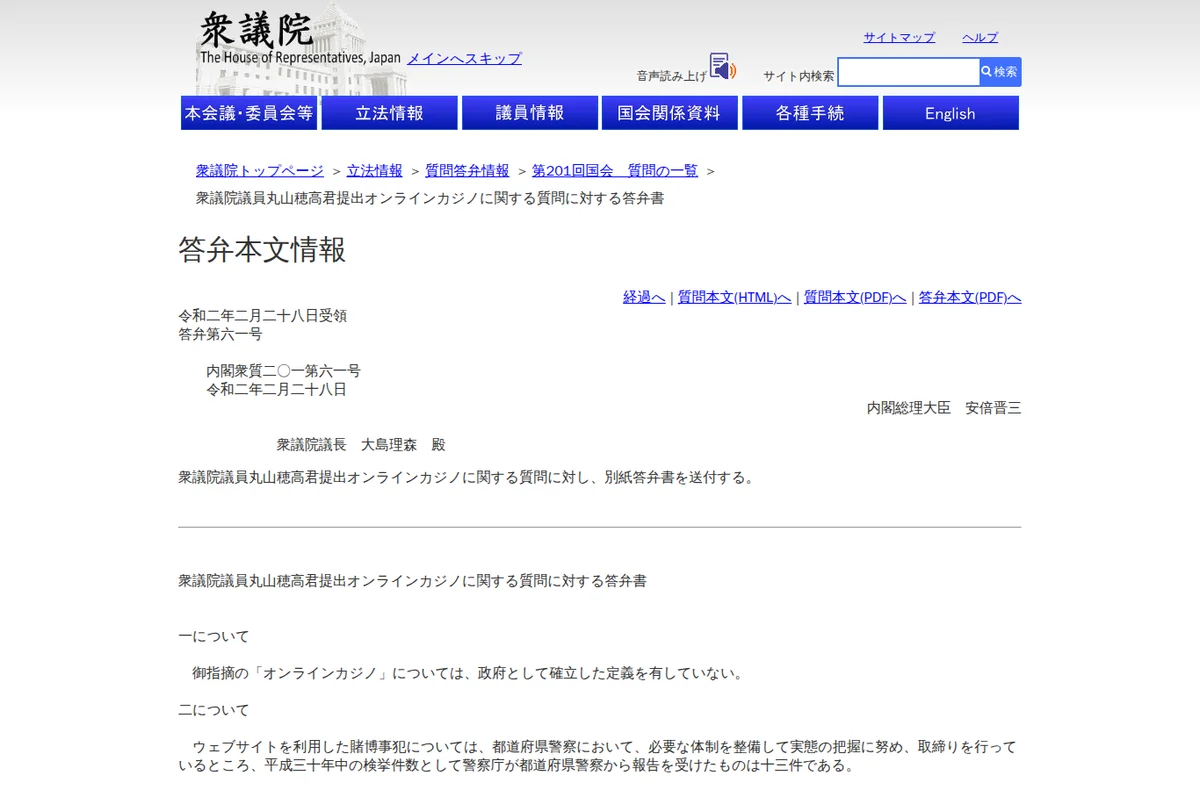
Many affiliate sites — and, until October 2026, an older version of our own Japanese article — said the third player’s case was dropped. We corrected it: the government’s written answer is the most authoritative record available, and it says all three received summary fines. The case is still important for a different reason: it showed that Japanese police treat play from a home in Japan at a foreign-licensed site under Article 185, which is the position the NPA has stated publicly ever since.
The 2025 amendment: what the new rules ban
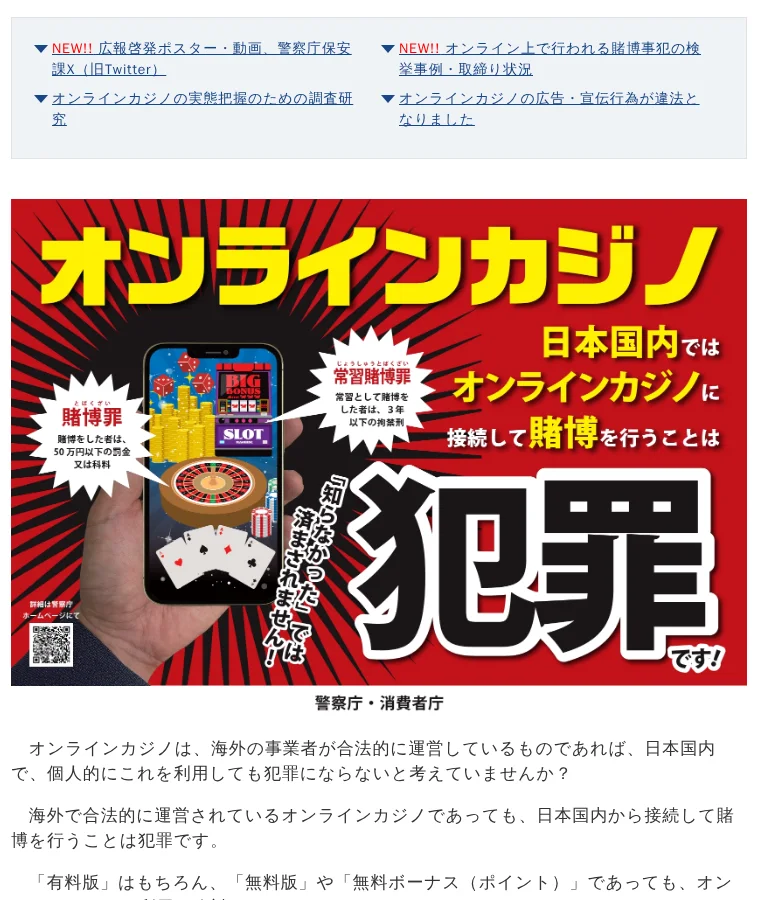
In 2025 the Diet amended the Basic Act on Gambling Addiction Countermeasures (e-Gov) (Act No. 76 of 2025). It was enacted on 18 June 2025, promulgated on 25 June and took effect on 25 September 2025 (NPA circular of 25 June 2025).
Article 9-2: two prohibited acts
The new Article 9-2 applies to anyone who publishes information on the internet to the general public. It prohibits:
- presenting an “illegal online gambling website” or app to unspecified people in Japan; and
- posting information on the internet that steers unspecified people in Japan towards illegal online gambling.
“Illegal online gambling” is defined as gambling conducted illegally over the internet within Japan. Services that merely provide space for other people’s content — such as platform operators, search engines and app store operators — are not covered. The NPA’s examples of prohibited conduct include running an online casino site, listing a casino app in an app store, and posting links, ads or “sign up here” invitations aimed at people in Japan (National Police Agency, online casino page).
What did not change
- The Penal Code penalties for gambling (Articles 185–186) are unchanged.
- The amendment does not create a licence or a legal route for online casinos; it targets the “entry points” — operators, apps and promotion directed at people in Japan.
- It adds a duty for national and local government to publicise the ban through schools, workplaces and local communities (Article 14).
What is clearly illegal in Japan
Some activities are not a matter of interpretation at all. Japanese affiliates warn about these first, and so do we — they are where players lose money with no protection whatsoever.
“Inkaji”: online casino cafés
An inkaji (internet casino shop) is a physical shop in Japan — often a back room in an entertainment district — where customers sit at PCs and bet on online casino games, paying and collecting cash at the counter. The shop is a gambling place under Article 186(2) (3 months to 5 years’ imprisonment for the organisers), and customers commit simple gambling under Article 185. There is no licence, no regulator and no recourse if you are not paid.
Sites run from inside Japan
A site operated from Japan cannot hide behind a foreign server. The Osaka High Court (9 February 2017) treated the organiser’s location and the players’ locations together as one “gambling place”, and in February 2024 Kyoto police arrested seven people who ran an online mahjong gambling site hosted on the Isle of Man from inside Japan. Japanese staff, a Japanese company address or payment collection in a Japanese individual’s bank account are red flags.
Unlicensed sites and payment agents
Sites that show no licence number, a number that does not match any register, or a licence holder that differs from the company in the terms and conditions are a separate risk: nobody supervises them. The same goes for “payment agents” that ask you to send money to a personal bank account — the NPA lists cases where collectors who disguised casino deposits as other payments were prosecuted under the Act on Punishment of Organised Crimes. Lending or borrowing bank accounts is a crime in itself.
| Situation | Why it is a problem | Rule |
|---|---|---|
| Inkaji shop in Japan | Physical gambling venue, no licence, cash only | Penal Code 185, 186(2) |
| Site operated from Japan | Operator in Japan = gambling place in Japan | Penal Code 186(2); Osaka High Court 2017 |
| No licence or fake licence | No regulator, no complaints route, no audited games | No protection under any law |
| Deposits to a personal account | Account abuse and money-laundering risk | Organised Crime Punishment Act |
| Promoting sites to people in Japan | Banned since 25 September 2025 | Basic Act on Gambling Addiction Art. 9-2 |
Offshore casino licences explained
Because Japan does not license online casinos, the licence an operator holds abroad is the only regulatory guarantee a player has. A licence tells you three things: which company is legally responsible for the site, which authority supervises it and can sanction it, and which rules on fairness, identity checks and anti-money-laundering it must follow. It is the first thing to check, and it takes two minutes.
| Licence | Regulator | Number format | Public register | Typical at Japan-facing sites |
|---|---|---|---|---|
| Curaçao | Curaçao Gaming Authority (CGA), under the National Ordinance on Games of Chance (LOK) | OGL/2024/xxx/xxxx (older); CGA/2025/… (new) | Curaçao Gaming Authority licence register | Most common |
| Anjouan | Anjouan Gaming, under the Anjouan Offshore Financial Authority | ALSI-xxxxxxxxx-FI1 / FI2 | Anjouan Gaming licence register | Common among newer and crypto-first brands |
| Malta | Malta Gaming Authority (MGA) | MGA/B2C/xxx/yyyy or MGA/CRP/… | MGA Licensee Register | European-facing brands |
| United Kingdom | Gambling Commission (UKGC) | Account number | UK Gambling Commission public register | UK-facing brands |
Curaçao (CGA)
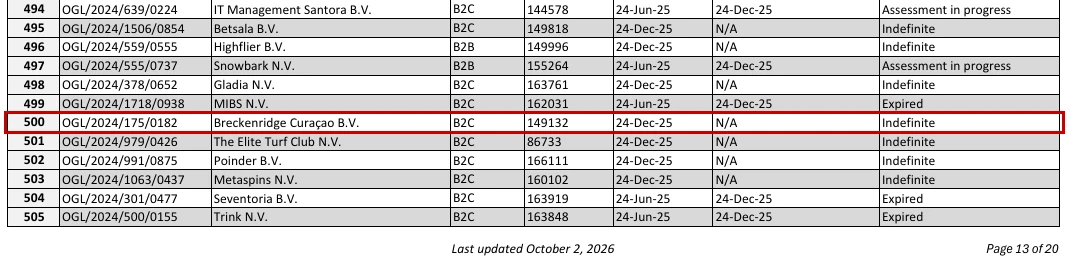
Curaçao rebuilt its system with the National Ordinance on Games of Chance (LOK). Licences are now issued directly by the Curaçao Gaming Authority to the operating company, replacing the old master-licence and sub-licence model. The CGA publishes its Online Gaming License Registry as a PDF; the edition of 2 October 2026 lists each licence number, licensee, company registration number, issue date, expiry and status (CGA Online Gaming License Registry (PDF, 2 October 2026)).
| Status in the CGA registry (2 Oct 2026) | Licences | What it means for you |
|---|---|---|
| Indefinite | 208 | Licence in force with no expiry date shown |
| Assessment in progress | 281 | The licence period shown has ended and renewal is being assessed — check again before depositing |
| Expired | 58 | No longer licensed under that number |
| Revoked | 49 | Licence withdrawn by the regulator |
Counts made by us from the CGA registry PDF dated 2 October 2026 (checked October 5, 2026). The CGA also notes that its online portal for operator submissions is offline and that this does not affect the validity of existing licences.
Anjouan
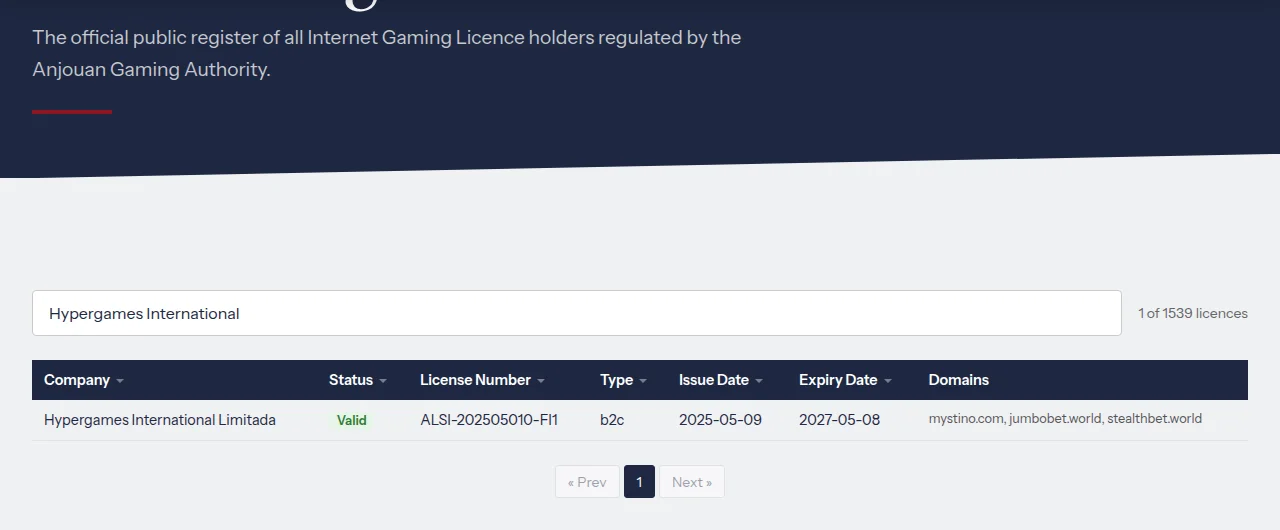
Anjouan, an autonomous island of the Union of the Comoros, licenses internet gaming through Anjouan Gaming under the Anjouan Offshore Financial Authority. Its online register lists the company, licence number, type (B2C/B2B), issue and expiry dates, status and the domains covered by each licence — which makes it easy to confirm that the exact site you are on is included.
Malta (MGA) and the UK (UKGC)
Malta and the UK are the most demanding regulators: both publish searchable registers, and the MGA adds a URL checker for domains. Few brands that target Japan hold them today; when you see an MGA or UKGC number on a Japanese-language site, check that the domain is actually listed — these regulators publish warnings about sites that misuse their names.
Real examples from our ranking
These are the licences shown by brands in our ranking of online casinos, each checked against the regulator’s own register on October 5, 2026:
| Brand(s) | Licensee (company) | Licence number | Register status |
|---|---|---|---|
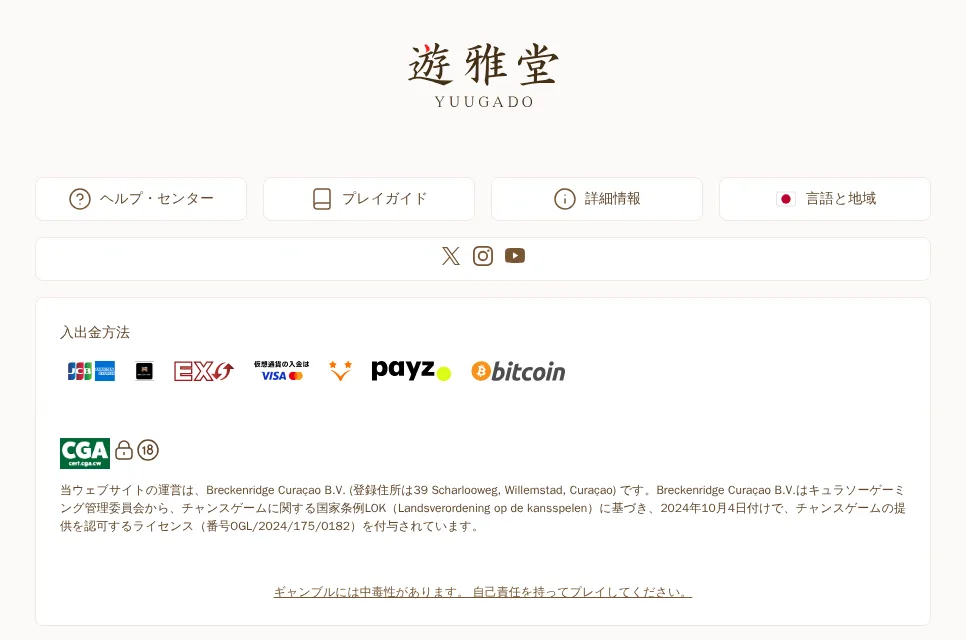
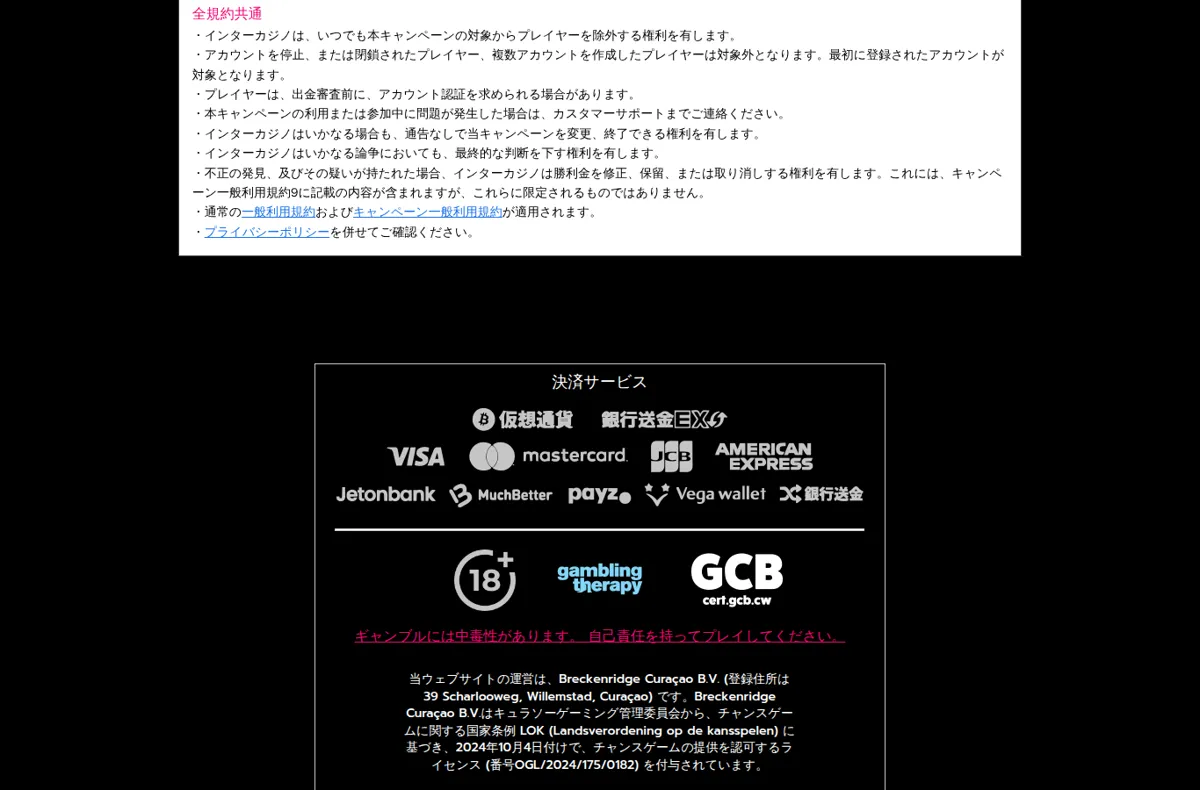
| Vera&John, InterCasino, Yuugado, Casino Secret | Breckenridge Curaçao B.V. | OGL/2024/175/0182 | CGA: Indefinite |
| JoyCasino, Casino-X | Katch Up N.V. | OGL/2024/863/0412 | CGA: Indefinite |
| Mystino, StealthBet | Hypergames International Limitada | ALSI-202505010-FI1 | Anjouan: valid, 9 May 2025 – 8 May 2027 |
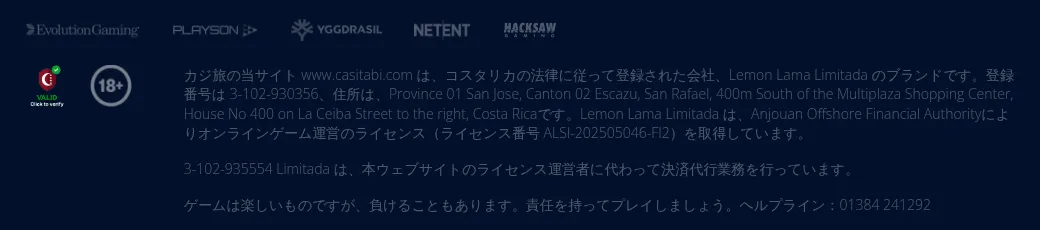
| Kajitabi (Casitabi), CasinoMe | Lemon Lama Limitada | ALSI-202505046-FI2 | Anjouan: valid, 29 May 2025 – 28 May 2027 |
How to verify a casino licence in five steps
- Scroll to the footer of the casino site or open its Terms and Conditions (usually section 1). Write down the company name, its registration number and the licence number.
- Identify the regulator from the number format: OGL/… or CGA/… is Curaçao, ALSI-… is Anjouan, MGA/… is Malta.
- Open the regulator’s own register — type the address yourself rather than trusting a badge, because seals can be copied. Use the links in the table above.
- Match three fields: licence number, company name and, where the register lists them, the domain. All three must match what the casino shows.
- Read the status. “Indefinite”, “valid” or “active” is what you want. “Assessment in progress” means renewal is pending; “expired” or “revoked” means stop there.
Why the licence protects you
- A responsible company: you know which legal entity holds your balance and owes you your withdrawals.
- A complaints route: regulators accept complaints and can suspend or revoke licences; the CGA and Anjouan both publish enforcement information.
- Fair games: licensed casinos offer games from established, tested providers with random number generators.
- Identity checks (KYC): annoying when you first withdraw, but they protect your account and are an anti-money-laundering requirement.
- Responsible gambling tools: deposit limits, cool-off periods and self-exclusion are standard at licensed sites.
Before you sign up: a seven-point checklist
- The law where you are. Confirm that online play is lawful in the country where you live and play. This page explains the Japanese position; other countries have their own rules.
- Licence verified. Number, company and domain match the regulator’s register, and the status is current.
- Same company everywhere. The company in the Terms and Conditions, the footer and the register is the same legal entity. A mismatch is a reason to walk away.
- Withdrawal rules read first. Check which identity documents are required, processing times, minimum and maximum withdrawals and any fees before your first deposit — not after your first win.
- Bonus terms understood. Wagering requirement, maximum cash-out, eligible games and expiry date. Our no deposit bonus guide compares these terms for current offers.
- Payments in your own name. Deposit only from accounts, cards or wallets that belong to you, and never send money to an individual’s personal bank account on a casino’s behalf.
- Limits set on day one. Turn on a deposit limit and a session reminder when you open the account; it is much harder to do once you are in the middle of a session.
Our list of licensed online casinos only includes sites whose operator and licence we have matched with the regulator, and we re-check them when registers are updated.
Foreign residents, tourists and Japanese living abroad
Nationality does not change how Japanese law applies: Article 1 of the Penal Code covers everyone in Japan. What changes is where you are and what you play. This table sums up the common situations.
| Your situation | Legal options in Japan | Online casinos |
|---|---|---|
| Tourist visiting Japan | Racing (20+), lottery, toto (19+), pachinko (18+); IR casino from 2030 with no entry fee | Japanese law applies while you are in Japan; the NPA position above applies to play from Japan |
| Foreign resident (work or study visa) | Same as Japanese residents; IR entry fee and visit limits will apply to you | Same position as for Japanese residents |
| Japanese national living abroad | Not applicable | Gambling is not in Article 3 (offences by nationals abroad); the law of your country of residence applies |
| Japanese tourist abroad | Not applicable | Licensed casinos in Macau, Korea, Singapore, the US etc. operate under local law |
If you are an expat in Japan, note one practical detail: under the IR Act it is residence, not passport, that decides whether you pay the ¥6,000 entry fee. Foreign nationals who live in Japan are treated like Japanese residents.
Gambling age in Japan
The age of majority in Japan dropped from 20 to 18 in April 2022, but the gambling laws kept their own limits. Most forms of gambling are still 20+.
| Activity | Minimum age | Legal basis |
|---|---|---|
| Horse racing (JRA and local) | 20 | Horse Racing Act, Art. 28 |
| Keirin | 20 | Bicycle Racing Act, Art. 9 |
| Auto race | 20 | Small Motor Vehicle Racing Act, Art. 13 |
| Boat racing | 20 | Motorboat Racing Act, Art. 12 |
| toto / BIG | 19 | Sports Promotion Lottery Act, Art. 9 |
| Takarakuji lottery | No legal minimum | Lottery Tickets Act (no age clause) |
| Pachinko / pachislot | 18 | Amusement Business Act, Art. 22(1)(v) |
| IR casino (from 2030) | 20 | IR Implementation Act, Art. 69 |
| Licensed online casinos (offshore) | 18 or 20 depending on the site’s terms | Operator’s licence and terms |
All statutes checked on e-Gov Law Search, checked October 5, 2026.
Tax on gambling winnings in Japan
Tax is a separate question from legality: Japanese income tax applies to income whatever its source. The general rules are set out by the National Tax Agency (National Tax Agency, Tax Answer No. 1490, checked October 5, 2026). This is a summary for residents of Japan, not tax advice.
| Winnings from | Tax treatment | Basis |
|---|---|---|
| Takarakuji lottery | Tax-free | Lottery Tickets Act, Art. 13 |
| toto / BIG | Tax-free | Sports Promotion Lottery Act, Art. 16 |
| Horse, boat, bicycle, auto racing | Occasional income (ichiji shotoku) | Income Tax Act Art. 34; NTA No. 1490 |
| Overseas casinos and online casinos | Generally occasional income | Income Tax Act Art. 34; NTA No. 1490 |
How occasional income is calculated
Occasional income = total winnings − money spent directly to obtain those winnings − a special deduction of up to ¥500,000. Only half of the result is added to your other income. Example: ¥700,000 in winnings from bets that cost ¥100,000 gives ¥700,000 − ¥100,000 − ¥500,000 = ¥100,000, of which ¥50,000 is added to your taxable income. Losing bets are generally not deductible, so a year with a net loss can still produce taxable income.
Non-residents are generally taxed only on Japan-source income, and tax treaties may apply. For anything beyond the basics, ask a licensed tax accountant (zeirishi). Our Japanese guide to casino tax has worked examples.
Is sports betting legal in Japan?
Only in the forms the law creates. You can legally bet on horse, boat, bicycle and motorcycle races and on J.League and B.League results through toto/WINNER. There is no licence for fixed-odds bookmakers in Japan. The government’s public relations site specifically says that online sports betting is gambling and distinguishes it from the public races and toto (Government of Japan Public Relations Online). Major international bookmakers are licensed abroad, and several have withdrawn from Japan in recent years.
| Product | Status in Japan |
|---|---|
| Horse, boat, keirin, auto race | Legal, run by public bodies, online via official services (20+) |
| toto / BIG / WINNER (football, basketball) | Legal, run by the Japan Sport Council (19+) |
| Fixed-odds sports betting | No Japanese licence; operators are licensed abroad |
| Betting on baseball (NPB) or sumo results | No legal product in Japan |
Our guide to sports betting in Japan covers how licensed international sportsbooks work, the sports Japanese bettors follow and which brands have left the market.
Is poker legal in Japan?
Poker for cash stakes is gambling under Article 185 like any other game: there is no skill-game exemption in Japanese law. What is legal — and popular — is amusement poker: poker bars and rooms in Tokyo, Osaka and other cities where you buy chips for the evening but cannot cash them out. These venues operate under the Amusement Business Act, whose Article 23(2) forbids game venues from giving prizes based on results.
- Legal: amusement poker rooms with no cash prizes; free tournaments where prizes come from a sponsor rather than from players’ entry fees; play at licensed casinos abroad.
- Not legal: cash games or tournaments in Japan where players’ money forms the prize pool.
- Online poker: no Japanese licence exists; the NPA position on online gambling from Japan applies.
More detail, including how live tournament series handle prizes, is in our guide to poker in Japan.
Responsible gambling: help in English and Japanese
Whatever you play, set a budget before you start, use the deposit limits and time-outs that licensed sites provide, and stop if gambling stops being fun. If you or someone close to you is struggling, these services are free:
| Service | Language | What it offers |
|---|---|---|
| TELL Lifeline | English | Free, anonymous phone and chat support for anyone living in Japan: 0800-300-8355 (toll-free) |
| National Center for Addiction Services Administration (NCASA) | Japanese | Nationwide directory of gambling addiction counselling, clinics and self-help groups |
| Mental Health and Welfare Centres (seishin hoken fukushi sentā) | Japanese | Free gambling addiction consultations in every prefecture and designated city |
| Gamblers Anonymous Japan | Japanese | 256 self-help groups meeting in all 47 prefectures (October 2026) |
| Gamblers Anonymous (international) | English | Meeting finder and online meetings |
| Consumer Hotline 188 | Japanese | Debt and contract problems |
Our Japanese responsible gambling page explains the self-exclusion and limit tools offered by licensed casinos step by step.
Common myths about gambling law in Japan
A lot of what circulates about Japanese gambling law is out of date or simply wrong. These are the claims we see most often, set against the primary sources.
| What you may read | What the sources say | Source |
|---|---|---|
| “A foreign licence makes online casinos legal in Japan.” | A licence is valid in the country that issues it. Japan has no online casino licence, and the NPA’s position covers sites legally run abroad. | NPA; Penal Code Art. 1 |
| “Japan has no law that applies to online gambling.” | Articles 185–186 of the Penal Code apply; the government lists this claim as a misconception. | Gov-Online (2025) |
| “One of the Smart Live players was cleared.” | All three received summary fines of ¥200,000 or ¥300,000. | Cabinet answer, 28 Feb 2020 |
| “Casinos became legal in Japan in 2018.” | Only inside approved integrated resorts; none is open yet, and online casinos are not covered. | IR Implementation Act |
| “Pachinko is legalised gambling.” | Pachinko is an amusement business; parlours cannot pay cash or buy back prizes. | Amusement Business Act Art. 23 |
| “Paying in crypto puts you outside the law.” | The payment method does not change how the Penal Code defines gambling. | Penal Code Art. 185 |
| “A VPN changes where you are playing from.” | Japanese law looks at where the act takes place, and a VPN does not move you. | Penal Code Art. 1 |
| “The 18+ age of majority lets 18-year-olds bet on races.” | The racing laws still say 20; toto says 19. | Racing Acts; Sports Promotion Lottery Act |
Timeline: gambling law in Japan
| Year | What happened |
|---|---|
| 1907 | Penal Code enacted, including Chapter 23 on gambling and lotteries (Articles 185–187) |
| 1948 | Horse Racing Act, Bicycle Racing Act and Lottery Tickets Act create the first legal exceptions |
| 1950–1951 | Small Motor Vehicle Racing Act (auto race) and Motorboat Racing Act |
| 1948 | Amusement Business Act sets the framework later used for pachinko parlours |
| 1998 | Sports Promotion Lottery Act (toto) |
| 2016 | IR Promotion Act passed; Kyoto police arrest three players of a UK-based online casino (March) |
| November 2016 | Cabinet written answer on the pachinko prize exchange |
| 2018 | IR Implementation Act and Basic Act on Gambling Addiction Countermeasures enacted |
| February 2020 | Cabinet written answer: all three Kyoto players received summary fines; no plan to amend the gambling provisions |
| April 2022 | Age of majority lowered to 18; gambling age limits stay at 20 (19 for toto) |
| 14 April 2023 | Osaka IR plan approved |
| 1 June 2025 | Penal Code reform: “choeki” and “kinko” merged into “kokinkei” (imprisonment) |
| 25 September 2025 | Amended Basic Act on Gambling Addiction Countermeasures in force (Article 9-2) |
| Autumn 2030 | Target opening of the Osaka IR |
Years of enactment taken from the official law numbers on e-Gov Law Search; events from the sources listed at the end of this page.
Bottom line
- Gambling in Japan is prohibited by the Penal Code unless a specific law allows it: racing, lotteries and toto are legal; pachinko works through the three-shop system; casinos will arrive with the Osaka IR in 2030.
- There is no Japanese online casino licence. Online casinos used by Japanese players are licensed abroad, and the NPA considers betting from inside Japan to be gambling under the Penal Code.
- The 2016 Kyoto (Smart Live) case ended with summary fines for all three players, according to the government’s 2020 written answer.
- Since 25 September 2025, showing illegal online gambling sites to people in Japan and steering them there is banned.
- If you play online where it is lawful for you, choose a site whose licence you have checked in the regulator’s register — our licensed casino list is a starting point.
Your responsibility
Gambling laws differ from country to country, and only the laws of the place where you are apply to you. Follow the laws where you live — whether and where you play is your own responsibility. Never gamble with money you need, and never borrow to gamble.
Frequently asked questions
Q. Is gambling legal in Japan?
A. Gambling is prohibited by the Penal Code (Articles 185–187) except where a specific law allows it. Horse, boat, bicycle and motorcycle racing, the takarakuji lottery and the toto sports lottery are legal and run by public bodies. Pachinko operates legally as an amusement business, and casinos will be allowed inside licensed integrated resorts.
Q. Why is gambling illegal in Japan?
A. The Penal Code of 1907 bans gambling by default. Later laws allow only games run by public bodies for public purposes — supporting agriculture and horse breeding, industry, local government finances and sport — with fixed payout rates and age limits. Private gambling businesses have no such law behind them.
Q. Is online gambling legal in Japan?
A. Japanese law has no licensing system for online casinos, so no online casino is licensed in Japan. The sites Japanese players use are licensed abroad. The National Police Agency considers betting at them from inside Japan to be gambling under the Penal Code. Online betting on the public races and toto through official services is legal.
Q. Are online casinos licensed in Curaçao or Anjouan legal?
A. They are legal businesses in the jurisdiction that licenses them, and the licence is the best guarantee of who runs a site. A foreign licence does not create a Japanese permit; how the law applies to you depends on where you are.
Q. What happened in the Smart Live Casino case?
A. In March 2016 Kyoto police arrested three people who played at a UK-based online casino from their homes. According to the Cabinet’s written answer of 28 February 2020, all three were indicted by summary procedure and fined ¥200,000 or ¥300,000. The often-repeated claim that one case was dropped is not supported by that record.
Q. What did the 2025 law change?
A. From 25 September 2025 the amended Basic Act on Gambling Addiction Countermeasures bans showing illegal online gambling websites or apps to people in Japan and posting information that steers them towards illegal online gambling. It targets operators and promotion; the Penal Code penalties were not changed.
Q. What is the gambling age in Japan?
A. 20 for horse, boat, bicycle and motorcycle racing and for IR casinos, 19 for toto, 18 for pachinko, and no legal minimum for the takarakuji lottery.
Q. Is pachinko gambling?
A. Legally, pachinko is an amusement business. Parlours may only give prizes and may not pay cash or buy prizes back; separate exchange counters buy the prizes. The government has said this is lawful as long as the exchange is genuinely independent of the parlour.
Q. Is sports betting legal in Japan?
A. Betting on the public races and on J.League and B.League results through toto/WINNER is legal. There is no Japanese licence for fixed-odds sportsbooks, and the government treats online sports betting with them as gambling.
Q. Is poker legal in Japan?
A. Poker for cash stakes is gambling under the Penal Code. Amusement poker — rooms and tournaments with no cash prizes — is legal and widely available in big cities.
Q. Are there casinos in Japan?
A. Not yet. The IR Implementation Act allows up to three integrated resorts with casinos. The first, in Osaka, was approved in April 2023 and is targeting an opening in autumn 2030. Until then there are only amusement casinos with no cash prizes.
Q. Can foreigners gamble in Japan?
A. Yes, on the same legal products as residents: racing (20+), lottery, toto (19+) and pachinko (18+). At the future IR casinos, foreign visitors will pay no entry fee, while residents — including foreign residents — will pay ¥6,000 and face visit limits.
Q. Do I pay tax on gambling winnings in Japan?
A. Lottery and toto prizes are tax-free. Racing and casino winnings of Japanese residents are generally occasional income: winnings minus the cost of the winning bets minus up to ¥500,000, with half of the result taxed. Ask a tax accountant for your case.
Q. How do I check if an online casino is licensed?
A. Find the company name and licence number in the site footer or terms, open the regulator’s own register (CGA, Anjouan Gaming, MGA or UKGC), and check that number, company and domain match and that the status is valid or indefinite.
Q. Can tourists play pachinko in Japan?
A. Yes. Pachinko parlours are open to anyone aged 18 or over, including foreign visitors. You exchange your balls for prizes at the counter; separate exchange windows near the parlour buy special prizes, under the three-shop system.
Q. Is mahjong for money legal in Japan?
A. No. Mahjong parlours are licensed under the Amusement Business Act, and Article 23(2) forbids them from giving prizes based on results. Playing mahjong for cash stakes is gambling under Article 185 of the Penal Code; playing for fun, or for something like the cost of a meal consumed on the spot, is not.
Q. Is it legal for Japanese people to gamble abroad?
A. Gambling is not among the offences Japanese nationals can be prosecuted for when committed abroad (Penal Code Article 3), so playing at a licensed casino in Macau, Korea or Las Vegas is governed by the local law.
Sources
Primary sources, all opened on October 4–5, 2026 (Japanese government sites from a Japanese IP):
- Penal Code (e-Gov Law Search) — Articles 1, 3, 35, 185–187
- Horse Racing Act, Bicycle Racing Act, Motorboat Racing Act, Small Motor Vehicle Racing Act, Sports Promotion Lottery Act (e-Gov)
- Amusement Business Act (e-Gov) — Articles 22 and 23
- IR Implementation Act (e-Gov) — Articles 69, 176, 177
- Basic Act on Gambling Addiction Countermeasures (e-Gov) — Article 9-2 (in force 25 September 2025)
- National Police Agency, online casino page
- Government of Japan Public Relations Online
- NPA circular of 25 June 2025
- Cabinet written answer No. 61, 28 February 2020 (Kyoto case, 2016)
- Cabinet written answer No. 157, 29 November 2016 (pachinko prize exchange)
- National Tax Agency, Tax Answer No. 1490 (occasional income)
- Japan Tourism Agency (MLIT), Osaka IR timeline; City of Osaka, Osaka IR page
- Curaçao Gaming Authority licence register; CGA Online Gaming License Registry (PDF, 2 October 2026)
- Anjouan Gaming licence register; MGA Licensee Register; UK Gambling Commission public register
Related pages: Online casinos in Japan · Sports betting · Poker · Pachinko · Casinos in Japan · Japanese version (日本語)